
Summary:
Upfront Installation Costs: Concrete vs Pavers in Long Island
Concrete driveways typically run between $4 and $15 per square foot installed, while paver driveways command a higher investment, generally ranging from $10 to $30 per square foot installed. For a standard two-car driveway (roughly 600 square feet), you’re looking at $2,400 to $9,000 for concrete versus $6,000 to $18,000 for pavers.
But here’s what those estimates don’t tell you. Labor takes up about 40-60% of concrete installation costs, while paver installation is more hands-on with labor representing 60-70% of the final bill. This makes sense when you consider pavers require careful hand-placement while concrete can be poured mechanically.
The price gap narrows when you factor in Long Island-specific considerations. Here in New York’s coastal region, costs typically run higher than national averages due to local conditions and skilled labor demands.
What Drives Driveway Installation Costs in Nassau and Suffolk Counties
Size and layout complexity play a major role in budget calculations. While square footage is the obvious cost driver, curved edges or circular designs add 15-30% to your total investment due to more precise cutting and fitting.
Long Island’s soil conditions create additional challenges. The region’s sandy soils can contribute to uneven settling, creating stress points that require extra base preparation. Real-world conditions like soggy corners, massive oak tree roots, and steep slopes requiring extra base material make every project unique.
Material grade and quality significantly impact both performance and price. For concrete driveways, higher PSI ratings (4,000+ compared to standard 3,000-3,500) provide better durability but at higher cost. With pavers, you’re choosing between basic concrete pavers and premium options like natural stone or tumbled varieties.
Don’t forget the hidden costs. Disposal fees can be a real budget-buster if you’re replacing an existing driveway, with hauling away old concrete or asphalt typically costing $2 to $8 per square foot. We can sometimes crush old concrete and reuse it as base material, potentially saving you money.
Site accessibility matters too. Access challenges arise when heavy equipment needs to reach backyards, and any complications boost costs. If irrigation systems need relocation or fancy patterns require intricate cutting, expect additional charges.
Long Island Climate Impact on Installation Costs
Choosing the right season and conditions for installation is crucial for durable results. We plan projects when both air and ground temperatures are warm but not extreme, ideally between 50°F and 90°F.
Long Island’s coastal environment adds complexity to any driveway project. High humidity levels and frequent exposure to salty air and coastal flooding weaken concrete over time, making it more susceptible to freeze-thaw damage. This means we often recommend higher-grade materials and specialized installation techniques.
The northeastern climate adds another layer of complexity, with freeze-thaw cycles testing the durability of both options. While concrete may develop cracks over time, properly installed pavers can flex with ground movement, often providing better long-term performance in our region.
Winter installation challenges can drive up costs significantly. We may charge premiums for cold-weather work or recommend waiting until spring. Seasonal checks after Long Island winters with freezing and thawing cycles help catch problems early, but prevention during installation is key.
The moisture management requirements in our region often necessitate enhanced drainage solutions. Every driveway should be installed with proper grading and drainage planning to prevent puddling, ice buildup, and erosion, with French drains or trench systems when needed.
Long-Term Maintenance and Lifespan Analysis
Here’s where the real cost comparison gets interesting. Well-installed paver driveways can last 50+ years with minimal maintenance, whereas concrete driveways may need major repairs or full replacement within 10-20 years.
Asphalt driveways typically last 15-20 years before full repaving is needed, while concrete driveways often last around 30 years. We consider concrete driveways over 30 years old near the end of their lifespan.
The maintenance schedules tell the story. Asphalt requires sealcoating every 2-3 years as a thin protective layer that prevents oxidation and minor surface damage. For concrete driveways, apply concrete sealer on cracks or stains to maintain appearance.
Freeze-Thaw Damage: Long Island's Biggest Driveway Enemy
Water that seeps into concrete cracks can freeze and expand during cold winters, causing the cracks to widen and the concrete to deteriorate. This cycle repeats as temperatures fluctuate, weakening the material over time.
Fluctuating winter temperatures frequently shift above and below freezing, accelerating the freeze-thaw cycle. This constant temperature variation causes trapped water within concrete to repeatedly expand and contract, leading to cracks, scaling, and other forms of damage.
When temperatures on Long Island typically hover between 20° and 40° during winter, water continually freezes and thaws. Water turns to ice and expands with substantial force, stretching or breaking the material. Water gets into the substrate of your driveway, and deep freezes create expansion that breaks up asphalt and creates potholes.
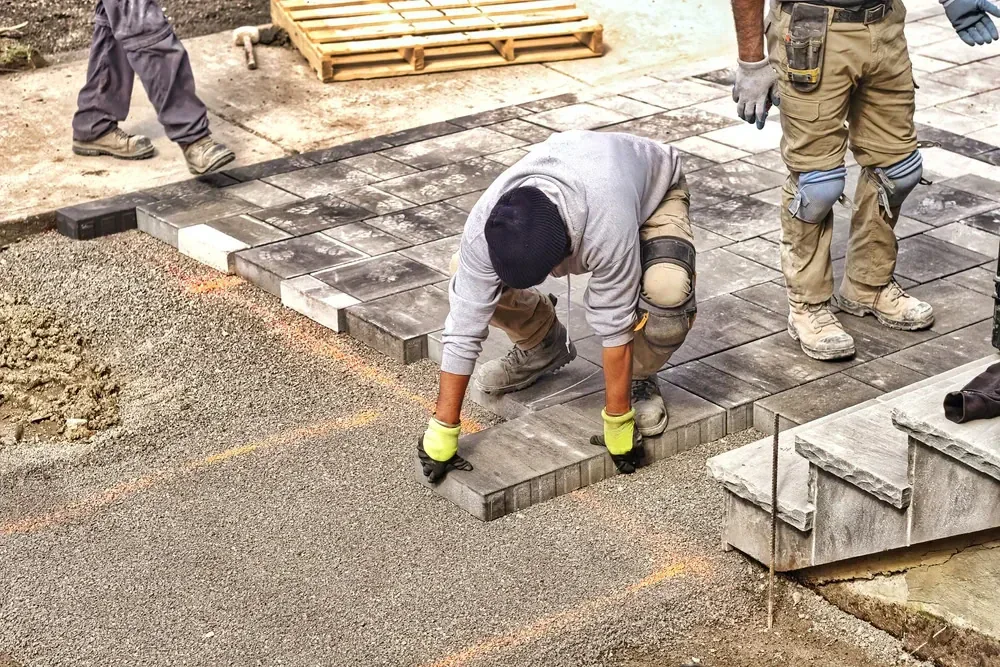
Pavers handle this challenge differently. Pavers are designed to be interlocking and flexible, which means they resist cracking. If a paver is damaged, it can be easily replaced without affecting the surrounding area. Pavers hold up better in harsh weather and typically don’t crack from freeze-thaw cycles.
The prevention strategies vary by material. Regularly seal your driveway to prevent water from seeping into cracks. Address cracks and low spots immediately, and apply a sealant every few years to protect the surface. Concrete is sensitive to salt-based de-icers which can easily damage it. Avoid sodium chloride and choose safer alternatives such as calcium magnesium acetate.
Maintenance Cost Breakdown Over 20 Years
Let’s crunch the real numbers. Nassau County homeowners should schedule sealcoating services every 2-3 years, with sealcoating shielding asphalt pavement from UV rays, salt, and water. At $200-400 per application, that’s $1,600-3,200 over 20 years just for sealcoating.
Crack filling using asphalt crack filler or cold-patching materials stops water from seeping into the base and sub-base. Professional crack sealing runs $150-300 per session, and you’ll likely need this 3-4 times over two decades.
Over time, maintenance costs for a concrete driveway can add up, making pavers the more economical choice in the long run. Concrete pavers are easy to maintain, requiring minimal upkeep to keep them looking great.
Paver driveways need resealing every 3-5 years at $200-400 per application, but the key difference is repairability. If a paver gets damaged, you can simply replace the individual piece without disturbing the overall structure. This not only maintains the aesthetic integrity but also adds to long-term sustainability.
The math becomes clearer when you factor in major repairs. Unlike pavers where you can replace individual units, damaged concrete often requires more extensive and expensive repair solutions, such as patching or complete replacement of large sections. A single concrete repair can cost $500-2,000, while replacing a few damaged pavers might run $100-300.
Winter damage prevention also varies in cost. Most deicers, like rock salt, attack concrete driveways by eating away the top layer and causing cracks. The safer alternatives cost more upfront but prevent expensive repairs later.
Return on Investment and Resale Value Impact
Studies show that a new driveway can yield a 50-75% return on investment at resale. 72% of homebuyers say curb appeal influences their first impression, and a well-maintained driveway can increase perceived home value by up to 10%.
According to real estate experts, homes with attractive outdoor features can see an increase in value of up to 15%, with the cost of installing paver stones often recouped during the sale. Agents say asphalt driveways could boost home value by 5-10%, but the premium materials command higher returns.
Homes with paved driveways sell 7-10 days faster than those with gravel or dirt surfaces. In Long Island’s competitive real estate market, this timing advantage can be crucial. The key is matching neighborhood standards while offering something special that catches buyers’ attention without looking out of place.